A Day at High Caliber Ranch
What does a hunting day actually look like with us? Early coffee, a drive to the ground, hard hunting until dark, and a hot meal with the crew at the end of it. Here's the rhythm.
A day at Dunhams High Caliber Ranch starts before the sun does. One of the guides knocks on your door in the dark, and by the time you're pulling on your boots there's coffee on. We've been doing this on the same ground for more than thirty years, so there's a rhythm to it, and the morning is the first beat. Breakfast is the road-friendly kind, the sort of thing you can carry out the door and eat without slowing down, because the deer and elk don't wait for you to finish a second cup. Out here in the North Saskatchewan River valley, the mornings in season are cold, and a cold morning is a good morning. Cold means the animals are moving.
From the lodge it's a short drive out to where you'll hunt, and that drive is when your guide lays out the plan. He's not reading it off a sheet. These are guys who've worked this land for twenty years or more, and they know which cutline the bulls have been crossing, which river-hill bench holds bedded whitetail when the wind swings, and where the wind is going to be at first light versus midmorning. You'll talk it through on the way. If the wind's wrong for one spot, he's already got the next one in his head. That's the part you can't buy off an outfitter who just got the lease last year. Consistency is the whole point here, and it shows up in the small decisions before sunrise.
How you hunt depends on you. If you're fit and want to put boots on the ground, it's walk-and-stalk along the cutlines and river corridors, slipping through the pine and poplar, glassing the open grass meadows and the buck brush from the edges. The country is parkland and prairie river hills, thick bush broken up by grass, so a lot of the game is glassing patiently and then closing the distance when an animal commits to a feeding edge. If walking all day isn't in the cards, that's no problem and no judgment. We run the truck and the ATV, and plenty of great bulls and bucks have come off the side of a rig. The goal is to get you in front of a mature animal, however your legs and lungs want to do it.
You hunt the whole day. There's no coming back to the lodge at ten o'clock to nap. Instead, lunch comes to you. We set up a field tent and serve a hot lunch right out where you're hunting, so you stay in the country and stay warm. It's a real break in a real tent with real food, not a granola bar in your pocket, and on a raw afternoon a hot meal in the middle of the day does more for your morale than people expect. Then you're right back at it. The afternoon hunt runs all the way to legal light. Some of the best action of the day comes in that last half hour as the light goes flat and animals get on their feet to feed, so you stay put and you stay ready until the very end.
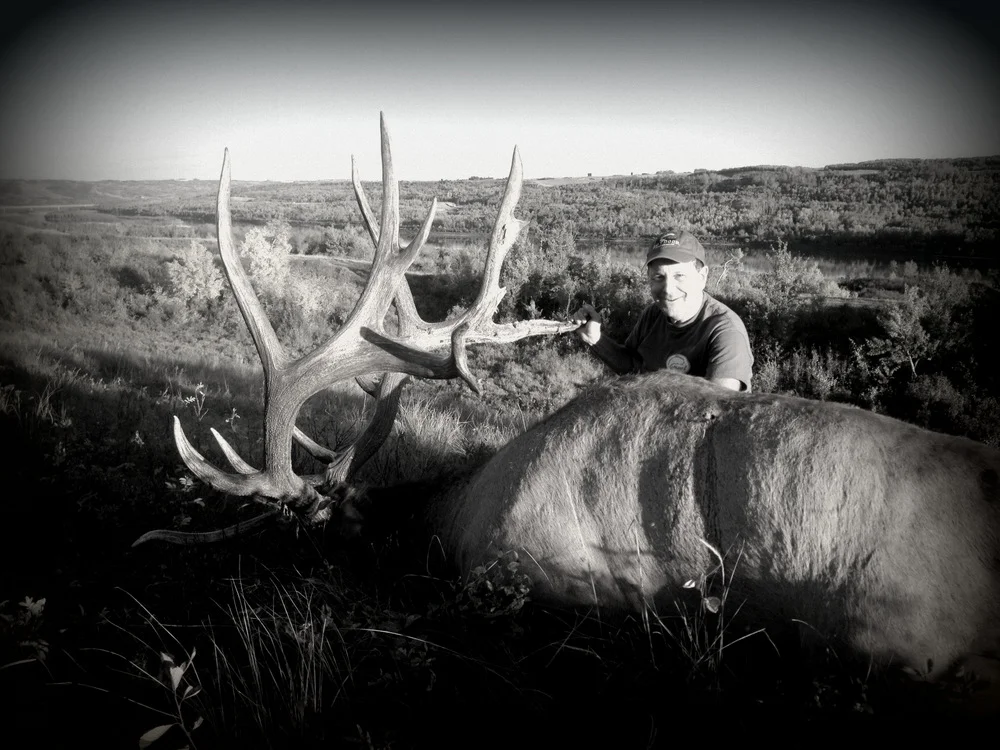
This is private, high-fenced land, and it's some of the oldest and largest privately held hunting ground in Canada, family-run the whole way. What you're hunting depends on the season. For elk it's Rocky Mountain bulls with big northern bodies, anywhere from seven hundred to twelve hundred pounds, ranging from solid 300-inch six-by-six management bulls up to genuine non-typical giants past five hundred inches. The rut runs September into October, and the bugling that time of year is something every elk hunter should hear at least once. For whitetail it's the Saskatchewan giants everyone's heard about, mature four- and five-year-old deer carrying real mass, the kind of bucks that make a guy's hands shake when they finally step into the open.
When you connect, the first thing we do is photos. Take your time. You earned the picture and you'll want it for the rest of your life, so we get it right before anything else. Then the guides take over. They load the animal and bring it back to the barn, where the trophy care gets handled properly, and you don't have to lift a finger if you don't want to. There's a spot in the barn we call the man cave where you can sit back, have a drink, and watch the work get done. Caping and freezing are included, and trusted exporters handle the antlers and capes when it's time for them to head home. If you want it, there's an optional deboning service for two hundred fifty dollars. Nobody's nickel-and-diming you on the basics.
Then comes dinner, and dinner here is not an afterthought. It's a multi-course meal put together by a camp chef who's been with us better than ten years. That tenure matters. Our cooks and lodge staff have been here fifteen years and up, the same faces season after season, and they know how to feed hunters who've been out in the cold all day. A lot of nights the plate features game from the season, which is about as honest as a meal gets, animals from this same country prepared by someone who knows exactly what to do with them. Beer and wine are included in moderation with dinner. If you want spirits, you can pick those up in Lloydminster on your way in, but the table itself is taken care of.
After dinner you end up by the fire, and that's where a hunt camp earns its keep. You recap the day, tell the story of the stalk that worked or the one that fell apart at sixty yards, and listen to the other hunters tell theirs. Then the guides start talking about tomorrow. They've already got a read on where you should be at first light, depending on what the wind's doing and what you saw today, and you'll go to bed with a plan. There's a camaraderie to it that builds over a few days. By the second or third evening you're not a client anymore, you're part of the camp, and the guys running this place are owners and partners, not booking agents passing you off to someone else.
It's worth saying a word about getting here, because some folks come in with the wrong picture. You fly into Edmonton or Saskatoon, both about two and a half hours from the lodge, then you rent a vehicle and drive in. There's no airport pickup and no jet or helicopter shuttling you to the door. That's just not how it works in this country, and we'd rather you know that going in than be surprised at the carousel. Arrival day has its own rhythm. You check in around eleven in the morning, have lunch, then head to the range to confirm your rifle is still zeroed after travel, which it sometimes isn't. Once you're shooting straight, you head out for a half-day hunt that very afternoon. You're hunting the day you arrive.
Because it's private land, the whole tags-and-draws headache disappears. There are no lotteries and no waiting years for a tag to come up. You book this season and you hunt this season, simple as that. Hunts are strictly limited, though. Elk is somewhere in the fifty-to-seventy-five range a year, whitetail has historically run around fifty-five, and once the calendar fills it closes. The elk rut in particular sells out a year ahead, so if September is what you're after, you don't sit on it. And the hunt is backed by a flat-out no-kill, no-pay guarantee, a hundred percent. If you don't get your animal, you don't pay for it. That's about as plainly as it can be put.
A note on gear, since it comes up every year. Dress in layers and you'll be comfortable from the cold dark morning through the warmer middle of the day. Start with a moisture-wicking base, add a wool or fleece mid-layer, and top it with a quiet, windproof shell, because on a stalk you cannot have your jacket announcing you to every deer in the valley. Get waterproof, insulated boots and break them in before you come, not in the truck on the way out. Bring more than one pair of gloves and a warm hat. Before the trip you'll get a packet from us with the travel details, the firearm import forms for U.S. hunters, and a full gear list, so nothing about the logistics should catch you off guard.
That's the shape of a day here, dark to dark and then some, but it never feels like a grind because every piece of it is built around getting you a fair, honest crack at a great animal and treating you right when you do. The man behind it, Rob Dunham, has spent his life at this and gets called a pioneer in Canadian whitetail outfitting for good reason, and his son Josh runs the operation alongside him now. If you want to talk dates, ask questions, or just hear more about how a week out here goes, give us a call at 780-871-1747. Bring warm clothes, a rifle you trust, and an appetite. We'll handle the rest, same as we have for thirty years.